
Draw the Double and Dump
The 1999 McDonogh lacrosse squad and the power of Friendship

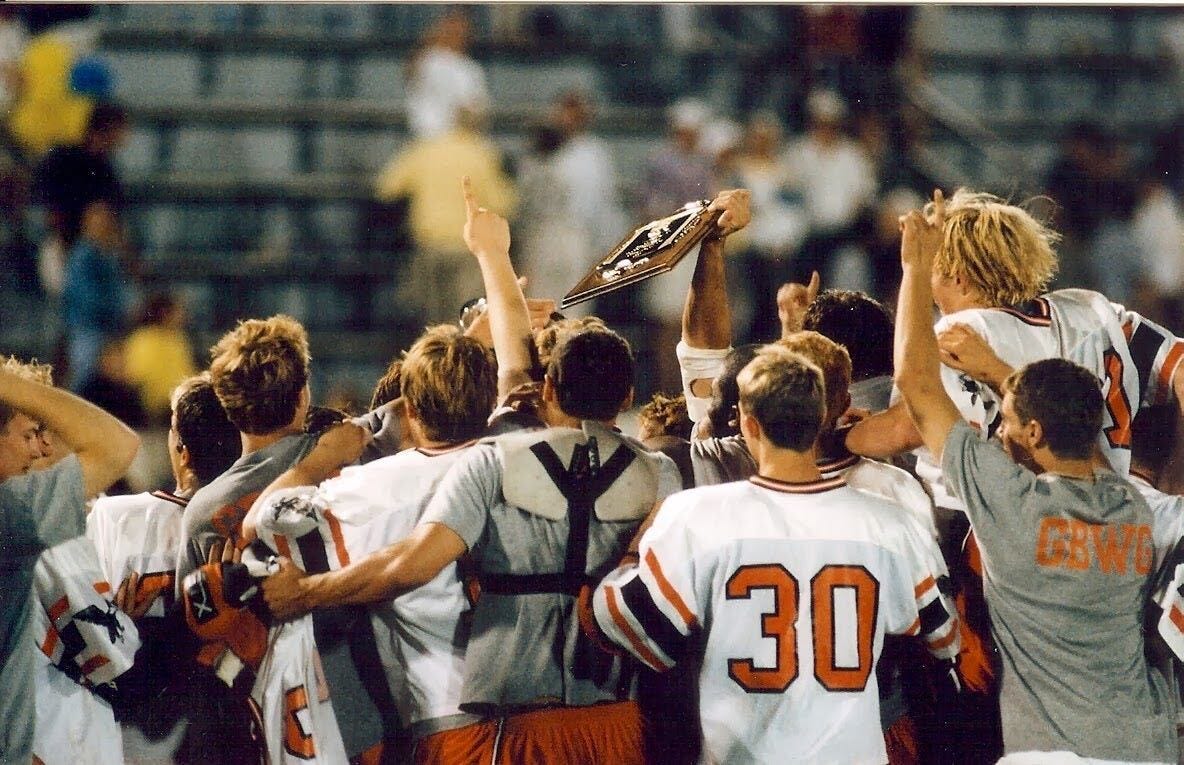
What follows is the story of the class of 1999 at McDonogh School and its lacrosse team. I recently spoke to the current McDonogh squad and thought I’d write this narrative down in a longer format. I don’t write this as a “rah-rah,” “we were so great” story. On the contrary, I’m writing this for the current McDonogh team, for the indispensable role players, for the good athletes who just started playing in 10th grade, and also for my own kids. I realize this long. I just got carried away wanting to tell the whole story.
Pre and Elementary School
It began in preschool when I met two of my first friends at Garrison Forest School in Owings Mills, Maryland. Our parents became friends and we used to go over to each other’s houses to watch movies like Ferris Bueller’s Day Off and eat pizza. Around then, I got my first cassette tapes by Genesis (didn’t age too well) and Bon Jovi (aged very well!).
The three of us, already pals, went to McDonogh for elementary school. The school was founded as a military academy in the 1870s for orphaned boys from the American Civil War. A hundred years after its start, McDonogh went co-ed and shed its military affiliation but still encouraged a feeling of stewardship, heritage, and service. It was a sprawling campus with athletic fields everywhere. The famous Middle School building with white pillars was built during the WPA program of the New Deal as I remember the story. The Memorial Field House included the basketball courts and PE locker rooms. It was decorated with portraits of the alumni who died in various conflicts. Many of those men graduated in 1939.
I was an energetic young boy. I appreciated that the PE classes at the Memorial Field House were a half mile away. Kids competed with one another to see who could get to the gym fastest. We ran through the doors to the gym every day past the stoic faces of members of the class of 1939 and others who gave their lives fighting for the country in World War II. They were like guardians. Joe was always right there in the front on that daily sprint.
But what to do during recess? I had to figure it out. I was playing soccer in first grade and thought I would join the soccer on the main field in a large game with other kids during recess. It was a giant swarm of 20 to 50 kids, loosey-goosey, with seemingly half the kids switching teams every five minutes. I didn’t like it. Even as a six-year-old, I wanted something with higher stakes. A week later, I moved to a different game on a different field to play football.
I am not sure why or under what structure, but our first-grade class had its own football game with its own rules. We played two-hand touch. We marked ten-yard first downs by taking giant steps. We picked teams each day. At first I was around last and gradually improved as time went on. Teams liked to play a hurry-up offense to catch the other team offsides. We vigorously enforced and debated pass interference. Teachers never intervened. The games were self-organized. They built a kind of physical trust among us. We came home with constant green grass stains and frequent rips in our shirts.
We also liked to play a game somewhat like rugby but with a football. In the game, one guy would get the ball and run as long and as far as he could. All the other guys tried to tackle and crush him until he coughed up the ball for the next person to do the same. If the Battle of Waterloo was won on the playing fields of Eton, future lacrosse games were won in these elementary school scrimmages. Apparently those self-organized football games had been going on long before us and continue to this day. What an institution!
Most of us played baseball, soccer, and maybe another sport or two in elementary school. We loved to play. I liked to call guys on the phone in a pre-cellphone era to rally our buddies to show up at school and play five on five on rollerblades. We liked to compete and win against one another.
One by one, our future lacrosse team began to take shape. I started to play lacrosse in third grade after noticing that Brian enjoyed it so much. Rob played defense and then goalie by middle school. I remember him scoring a bunch of goals in different lacrosse games too. Owen showed up in fourth grade. Brennan was already with us too. We were buddies before many of us ever picked up a lacrosse stick.
Lacrosse isn’t the easiest game to learn, but it’s one of the most rewarding. Somewhat like tennis, it requires significant hand-eye coordination particularly with respect to catching. Unlike in tennis, though, a player needs to be able to catch and throw the ball while being pushed and hit by opposing players. That’s what makes it fun but also very tricky. When a player gets better at that game and can handle the ball with a little bit of pressure, it’s among the best feelings in any sport, combining elements of football, soccer, ice hockey, basketball, and rugby.
The Sword, the Lacrosse Stick, and the Mid-Atlantic
We lived in the suburbs of Baltimore, Maryland. I don’t entirely know what it is about that area, but lacrosse was continues to be the main sport. Middle school boys would watch the big-time lacrosse games on Friday nights and then go see a game on Saturday at Hopkins, Towson, Loyola, or UMBC. To us, those players were regional heroes, many of whom grew up down the street from us and now played in what felt like giant stadiums. High school games frequently showed up on the front page of the newspaper. A taxonomy exists where anyone can quickly find out who is friends with whom in the area, even now, by asking when someone graduated and if he played lacrosse. People talk about high school and not where someone went to college. Some compare it to football in Texas or soccer in coastal Brazil. David Hackett Fischer wrote in his history book Albion’s Seed that the settlers in the Mid-Atlantic often carried swords wherever they went. At its best, Mid-Atlantic male culture encouraged a life of honor, self-comportment, and controlled aggression. We were supposed to be able to take hit after hit with a long metal pole on our arms and respond with a better play rather than a punch or a tear. We learned how to navigate a world that was both brutal and bound by strict rules of conduct. I have a pet theory that the lacrosse stick and the game’s controlled violence graft one culture onto the other. The University of Virginia has had an excellent lacrosse team throughout my whole life and their coat of arms features two swords.
Lacrosse is a violent game with metal poles pounding players’ arms and physical body checks. Fighting in a game or practice is heavily looked down upon. The culture expects that a player will be extremely aggressive on the field and a gentleman off of it. It doesn’t always work out that way, but that is how it works at its best.
I loved the game from the first practice and wanted to drop baseball quickly. We could go hard at one another and then high five afterward. We could go home to have pizza together on the weekend. I don’t want to oversell it though. We were still silly, goofy young boys who liked to run around and tackle each other.
Middle School
By fifth grade, enough of us were playing lacrosse that we could create a school team in our rec league. We moved into middle school. That was the world’s greatest summer. Blood Sugar Sex Magik, Metallica’s Black Album, Nirvana’s Nevermind, and Guns N’ Roses’ Use Your Illusion I and II were all released. Those albums provided an anchor to our childhood and adolescence. They were raw, forceful, strong, and intense. We had them on in the background for the next eight years and beyond. They even made it onto our warm-up tapes.
We played street hockey all summer, often at school. We competed at each other’s houses in any sport you could imagine. I remember one time someone had a mini lacrosse goal. We played one-on-one with Fiddlesticks for hours, interspersed with popsicles. Our parents knew each other. We knew one another’s siblings almost like they were our cousins. I knew we still needed to recruit more guys to this glorious game.
I liked that I could get better by throwing the ball against a wall. My dad bought a piece of wood from the hardware store and put it up against the shed. I used to go into our backyard and throw the ball against the wall just to blow off steam. I wanted to be able to throw and catch with both hands easily.
Like Jell-O in a freezer, our team started to take shape. In fifth grade, coached by the well-known ref Brian Abbott, our record was something like four and fifteen. We were at the very bottom of the league. We got destroyed, particularly against Gamber from our neighboring town. Our dear McDonogh friend and classmate, Matt, played attack for Gamber and had five goals against us, each catching the ball on the run, sneaking underneath our defense and quick-sticking the ball into the net.
We convinced Matt to play with us the following year in sixth grade as the team began to take a distinct shape. Brad joined us that year too. We were playing in the normal rec league and getting to the playoffs.
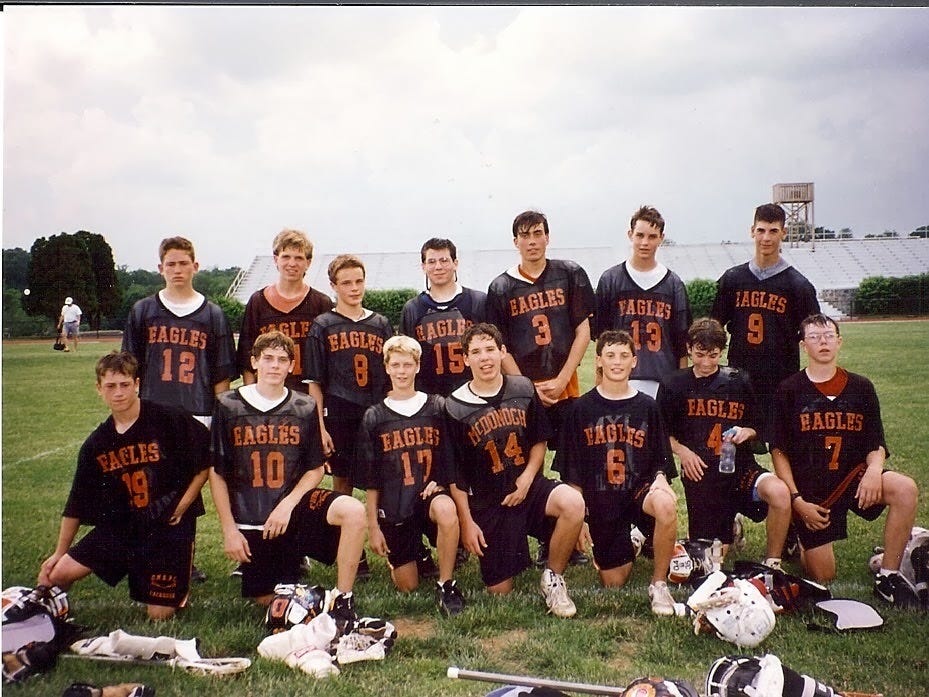
Already by then, our core team started taking shape with special characteristics. no ball hogs and an unselfish team. Then, in the future, and even now, I get an incredible amount of enjoyment passing to the open guy and “distributing the ball,” as the term goes in lacrosse. I like making the next pass, and I was joined on a squad that liked that too. We seemed to look at each other beating Kelly Post and in turn Cockeysville in middle school, to think to ourselves, wow, this could really be something.
In sixth grade, we first played for Jake Reed. He is now well known for founding the Blue Chip lacrosse camps. When we first met him, he taught at McDonogh and coached the varsity team. He played an incredibly important role in all of our lives. He grew up in the Baltimore area, played goalie for the University of Maryland, and had a world-class moustache. We called him Coach Reed as if “Coach” were his first name. He was incredibly tough and had an encyclopedic knowledge of the rule book. He never flinched in bad weather, regularly sporting thick red pants and a matching jacket.
Coach Reed believed strongly in a philosophy that has followed us to this day: If you do the same thing as everyone else, you should expect a mediocre outcome. If you want something very special, you need to put in an effort well above everyone else and take a unique approach. By growing a “pipeline” of players, he pioneered a system that was ahead of its time. The man paid attention and talked to us like we were already varsity players even though we were goofy, lanky middle schoolers. And we could see in varsity practice that they ran the same drills that we had.
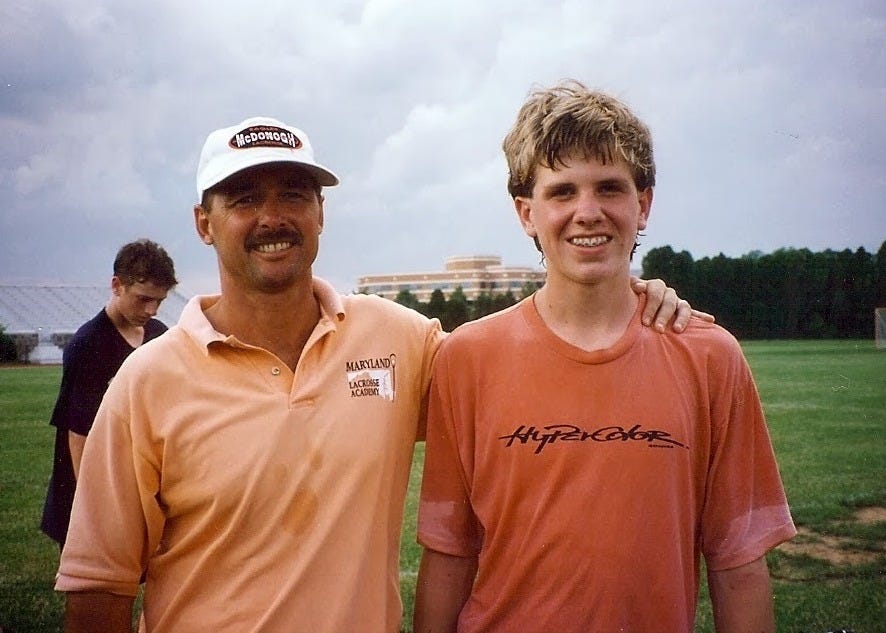
If we were dogging it, he would let us know to our faces in front of the whole team. He didn’t give us a “positive sandwich” and didn’t coat his feedback in the language of social emotional learning. We were fine with it. He expected that we would eventually be men. The world is a cruel place and you need to work hard and be focused to do anything well. During those years, we were establishing a culture among each other that mirrored his intensity.
Practices had some relaxed moments, like playing the Allman Brothers during playoff practices in May when the weather was good. Even then, he maintained incredibly high expectations for every player on the field. (To this day, the Allman Brothers star on my good-weather playlist.)
God bless Coach Reed: he used to field calls from me on this or that random night when I was in sixth grade. I’d ask the best way to play this or that defender in Perring Parkway’s Indoor program. (Answer: Move your feet aka stay in motion so it’s hard to guard you. Good advice.) We and our parents knew that we were in good hands with him because he worked us hard and encouraged us to be team players.
That year we were reading Henry David Thoreau in school. I put a quotation on my bedroom wall. It read, “If one advances confidently in the direction of his dreams, and endeavors to live the life which he has imagined, he will meet with a success unexpected in common hours.” It was the 1990s. All around us we were told to check out. We were told to wear baggy flannel shirts and that everything was a sham. Irony ruled the day. Bart Simpson and movie characters told us to question anything genuine. They said truth didn’t exist. Yet we could see something very different on the field and at our friends’ houses.
On our school team, we had a ridiculous list of coaches. Brian Voelker and Dave Marr from Hopkins, Brian Dougherty from Maryland, Scott Corrigan (of later Corrigan Enterprises), and of course Jake Reed steered the way. Tom Marechek ended up coaching us one year in high school and a bit in middle school. The level of talent on the coaching staff was absurdly impressive. I saw myself as the feeder on the team, and I had Dave Marr, one of the best in recent Hopkins history, teaching me how to see the field better. They taught us to make the extra pass, to trust each other, and to go hard every single day.
Lacrosse at McDonogh was still an underdog sport. When we were in sixth grade, the seventh-grade, eighth-grade, and high school teams weren’t that good. Football and baseball seemed to get most of the school credit. That winter I went to a dance at Loyola Blakefield, a rival team. While everyone was awkwardly trying to flirt with the Roland Park girls, I noticed two guys in the gym. They were wearing winter hats and throwing the ball against the wall. I knew then that McDonogh would only be able to win if we developed a culture like that. We needed guys who would hit the wall in their free time during the off-season without a coach watching.
We continued to have momentum in seventh grade, playing for our school and also a rec team together on the side. Then we all came back and played together by eighth grade. That was a fun year. That was the year Bobby joined us. I usually played point on the fast break. Most of the time, guys would come down the right-hand side and feed me the ball. I would either pass to Matt on the right side who was a great finisher or find the other attackman with a diagonal look.
I remember our first game together playing with Bobby against Lutherville. I think I had eight assists by feeding Bobby to score. Thankfully he could catch everything including passes at his feet. With the bulldog Matt on the right side and me stationed at X or at the point, we were unselfish and ready to pass to the open guy when covered. We had found something that worked so well.
Playing alongside Matt and Bobby ended up forming one of the great friendships of my lifetime. We didn’t stay up late talking on the phone or anything. Instead, we went on to start on high school attack each year. We played together as if we were joined at the hip. We knew where each player was without thinking about it. Gosh, I enjoyed playing with those two. I’m getting ahead of myself.
In eighth grade, we recruited Joe away from baseball to play defense for us. It was like Ringo joining the Beatles if Ringo were over six feet tall in eighth grade and one of the fastest kids in school. Joe could defend anyone on the field during his first year playing the game. Scott Corrigan was our head coach. If we stepped out of line in practice, we had to run around the wrought-iron goal on the other side of the field. That was later replaced by running around the wood even farther away. Coach Corrigan brought great energy to the team. He made us laugh and brought us together as a unit.
We began playing a very specific system with Coach Corrigan that lasted through high school and even into college. Our defenders were told never to get front-swung. They had to force the attackman and midfielders down the side and never across the front of the goal. If a defender was beaten, the slide would come from the crease. The second slide came from the backside defender or midfielder. On offense, we played a motion style. We dodged with short sticks from up top or with the attackman from the back of the goal. We were best when we moved the ball quickly from one side to the next. We were taught to draw the double and dump. You had to beat your first guy, draw a double team, and move the ball so the next player could find an open man on the other side. It worked because we believed that if you made the pass, you would get the ball back.
The summer after eighth grade, we played at Hopkins at Champ Camp against high school teams from across the country. We lost every single game and only scored a few goals in total which included one from our defenseman. High school looked like it was going to be a challenge.
Freshman and Sophomore Years
“It is amazing what you can accomplish if you do not care who gets the credit“
--President Harry S. Truman.
We rolled into high school knowing a few things. First, McDonogh had been in the B league for a long time and only recently had moved up to the A league. We hadn’t made it to the playoffs in twenty-five years and hadn’t won the championship since 1939. We had some guys to look up to. The year before, the squad played the best team in the country, Gilman, and won in overtime five to four. They used a slow-down style and a zone defense. That victory showed us that McDonogh kids could win. We weren’t a powerhouse. Things weren’t going to get any easier.
Freshman year felt incredible at first. We showed up to tryouts averaging about 140 pounds at five-foot-eleven. We got pushed around but we were able to move the ball. Coach Reed worked us hard. We didn’t stand in line very often. He didn’t give long speeches. Instead, we had to move our feet and go full speed. I remember our sprint laps at the beginning of practice. We had to run a lap around the field in 70 seconds, then 65, then 60, 55, and even 50 seconds, one after another. We played a lot of full field.
Freshmen made up half of our starting line that year. We were skinny skeletons with lacrosse equipment wrapped around us. We lost all of the games that we played in our conference. We got beaten up. We played some close games, but we just couldn’t win in our league. However, we won every non-conference game and never lost a single one during our entire high school career. Despite the conference losses, we knew we had something special. Despite being skinny, we could move the ball. We were old friends and we trusted each other from back on the playground in second grade. We made the extra pass because we knew we would get it back. I loved getting the assist as much as the goal. We just knew we had something.
Coach Reed scheduled many games that year because he wanted us to get repetitions. We often played the best teams in Pennsylvania, Virginia, or elsewhere. These teams had a different style. They usually had two excellent players on offense who dodged hard with their heads and shoulders down along with giant athletic defensemen. We figured out a way to beat them. On defense, we slid well to stop those athletic offensive players and forced them to make the third, fourth, and fifth pass. On offense, knowing we were going to get rushed on the first slide, we moved the ball around the goal to find the open guy. During our entire career at McDonogh, we never lost to a team outside of our conference.
25 years without going to the playoffs! 1939! Those memories rang out in our minds.
In one game our freshman year, we showed up for an away game against St. Paul’s. They were one of the best teams in the country. Parents on the sidelines arrived in easy-going summer dresses and what looked like summer cocktail attire. At first, based on what our own parents heard, the St. Paul’s crowd assumed it would be a leisurely game, and they would crush us. But the game turned into a grind. Body check after body check flew. We were able to whip the ball around the goal, using pass after pass to find the open man. The opposing parents tightened up. St. Paul’s ultimately won a very close game, but it gave us the sense that we could play and win against these teams.
We developed a problem. We couldn’t win games in overtime. This would become a recurring problem for us. None of us knows why, but I have a theory. We didn’t really have one guy who was obviously the boss and would take the last shot or draw all of the defenders. There was no LeBron James or Michael Jordan on our team who could either take the shot or draw four defenders. We had many different stars, so it wasn’t obvious when one guy had to be the one to win the game.
That summer after freshman year was brutal. A few guys almost made the first cut to the infamous all-star Bay State team, but none of us actually made it. I remember feeling incredibly down on myself and the team. I desperately wanted to get bigger and stronger only to suffer a stress fracture from an overuse injury. We were still so skinny. Of course, we continued to play other sports like soccer, football, basketball, and swimming. In the broader culture around us, all of the messages seemed to be telling us to stop caring. Movies like Trainspotting, Fight Club, and Reality Bites all told us that investing confidently in the direction of our dreams was foolhardy.
That summer a bunch of us went to lacrosse camps. I loved camps. I continue to think that a player probably gets more repetitions in a week of camp than in an entire season. He can try out new moves that his home coach would never allow. He can check out new positions. I loved it and so did my friends.
We showed up to sophomore year feeling slightly bigger and a little more confident. We beat a few teams on the lower rung of the conference and still won all of the games outside of the league. We knew we could play. Our coach also had a sense that we had to play to our strengths. We had an excellent goalie in Rob and incredible, patient talent on defense with players like Marcus. Our offense was still young. Consequently, we had to slow the ball down. We played a lot of zone defense and practiced against it on offense. We worked on slowing down the game and giving the ball to Greg and Kevin on short sticks behind the goalie.
We made it to the playoffs for the first time in 25 years in 1997. The opposing team we faced, Loyola, was one of the best teams in the country. I remember the strategy for the game well. Our coach told us to our faces that we were going to stall. There was no shot clock in those days so we wanted to keep the score low. We played a zone and forced them to overplay with their short sticks against our midfielders. This is not really an honorable way to play but it worked until we took them to overtime and lost. The guy who scored would later be my teammate in college. I was devastated at the time. However, after the dust settled, I felt proud. We had done something new for the school.
A week later, I went on a date with a girl to see the finals at Homewood Field at Hopkins. The game seemed so far away and yet so close. When we had played St. Mary’s, their defenseman seemed impenetrable. Yet, the attackman I was watching beat him every few plays. It seemed impossible that we could ever get to that level or that I would ever be able to match that kind of play.
Junior and Senior Year
During our junior year, we all played our different sports in the fall and the winter. We were upperclassmen now. We weren’t goons or bros and we weren’t getting into fights. As far as lacrosse players go, we were a fairly brainy bunch. Guys did their homework and cared about learning. Lacrosse players typically get a bad reputation, but our crew was a little bit different. We showed up in the spring a little bigger and confident in our place at school. We were like coiled springs. I couldn’t make varsity basketball and the coach gently encouraged me to lean in a bit more to the debate team. That wasn’t the worst advice I have ever received. When we hit the actual lacrosse field, it was a similar team, but we had lost some key veteran midfielders. Chris joined us after swimming season looking like a giant oak tree. More of us could handle the faster speed of sprint laps. Because we were juniors, we were playing the same guys that we had faced since seventh grade. The same players from those Cockeysville, Lutherville, and Kelly Post teams were now on all of the other high school teams. But like in any good conference, we knew that we wouldn’t be able to let up.
The season was incredible that junior year. We had only one regular season loss in overtime earlier in the season in the rain. Then we won about twenty games in a row. It was a stressful season in my memory. This was the year when college coaches really started to talk to us. The rule was that they could send letters but weren’t able to call us until later that summer. I remember I hadn’t received a ton of letters the first half of the season and I got really down on myself. Then I played two games very well and suddenly I got a bunch. One coach’s main recommendation to me in my game was that I eat a whole pizza every day.
I feel a real sense of regret thinking about those times. We had gone on probably the best run that the school had ever had. We were playing some of the best lacrosse in the country. Our ball movement was a wonder to observe. We had no weak players on offense and we trusted each other so well. Yet I spent way too much time and energy worrying and waiting breathlessly to get those letters when instead I should have been focusing and enjoying playing with my oldest friends.
I will add it here rather than in a lesson: we all could have found a place to play and to enjoy college lacrosse. There are so many teams across Division One, Two, Three, and Club that there is always a team that would have had us. Moreover, adult lacrosse after college is a blast too. I just regret that I allowed the recruiting process to overshadow time playing with my pals.
Thankfully, our bonds were so tight after more than a decade of having pizza in each other’s basements that we were able to move beyond those distractions. We had one fateful night in the semifinals at Homewood Field at Johns Hopkins at the end of the year. This was the farthest any McDonogh team had reached in many decades. However, our bus never arrived. We scrambled to get to the field together and, if I am remembering correctly, the game was slightly delayed for us. We eneded up playing against St. Paul’s in a very tight game. We ultimately lost in overtime.
We showed up for our senior year ready to make noise. We were bitter about the previous year and felt a sense of destiny behind us. A bunch of our players were captains of the cross country, soccer, football, and basketball teams. We had turned the culture at the school to a point where the focus was now on the spring. There was a buzz around school. We had all gotten into our colleges and we were here to fight. We knew it a bit at the time, but it is even more obvious now that our unironic desire to win put us directly against the broader 1990s culture of irony.
And here is a small digression about the importance of different role players in the game of lacrosse. In sixth and eighth grade, we played with just fourteen guys. We always said you could play with just two lines of midfield and maybe one extra attackman. Our faceoff guy was also a good midfielder who stayed on the field. By our junior and senior years, we had so many different important players. Austin and Vinny were incredible, fast, long-stick middies. We had backup defensemen who got to come in too. We ended up having incredible, future All-American attackmen who did not even get that much playing time that year, but they pushed us each day in practice.
We had a clutch set of defensive midfielders who are among the most important players in lacrosse. And here is the key for our readers. Often people ask me when they have to begin playing lacrosse, and I honestly say that a decent athlete can start his junior year. Playing good defense is just such a good skill and it does not require being able to shoot hard off hand on the run.
I never had the very best shot and was never the strongest on the team. But I was good, I think, at realizing we had been playing defense for a long time and needed to hold the ball on offense for a while. I could see who had a good matchup and get him the ball, or which side of the field had weaker defenders and push on that side. I think in hindsight my play functioned as a kind of lubricant for the team even though I was rarely scoring four or more goals a game. Also, it helped that I was surrounded by some incredible players. I still have the best memories of finding one of our best shooters open on the backside, throwing him a pass between defenders, and having him rip a shot that scores. It was a shot that I just could not have gotten by the goalie personally.
Breaking the Overtime Curse
We had a great season our senior year, but we faced two challenges. First, we lost to Loyola earlier in the year in the rain in overtime. It was an early loss and we got down. Then, as things progressed, we had one unusual game. We played Boys Latin, but Brad was out with an injury and I got a stomach bug. I was throwing up all day and just could not get out of bed. I am not trying to say that these two problems were enough to set us back, but in our league you usually could not spare any of these challenges. We lost that game and I felt horrible. However, that year no one went undefeated. The league had an impressive number of good players and we entered the playoffs with only two losses.
Teams did not really know how to guard us. We had some incredible dodging midfielders. Sometimes opponents would put two long poles on them and that would leave an attackman with a short stick. Sometimes they would not slide and our midfielders could usually score. We did a good job moving the ball quickly from one side of the field to the other after a midfielder drew a double team.
We played Gilman in an incredible game. They had decided to put a short stick on our six foot five lefty attackman! He may have had ten goals that game. We won 17-5. We saw them again a couple of weeks later in the semi finals at Homewood Field. One of their best players had been hurt in that giant win earlier and now he was back to face us in the semifinals. That really mattered. We fought goal by goal. He had the ball on the end line against our best defenseman, waiting and waiting. I remember those two minutes so clearly. It was a game of cat and mouse. The game was tied and we made the stop to send the game into overtime. We got the ball back, brought it down, and Bobby fed Matt to win the game. Bobby did not try to run through five guys. He knew Matt was open because of the years and games they had spent playing together. We finally won the game in overtime. We had defeated the monster that had been chasing us.
Passing the Baton
We only had one more game. After our disappointing junior year ending, we just did not know what to expect. Everything had led to this moment. We met Loyola in the finals. We had a chance to become the first McDonogh team since 1939 to win and possibly be the best team in the country.
I am not sure who organized this or the names of the men who were there, but around that time, we had dinner after school with the surviving members of that 1939 team. They won that lacrosse game and almost all of them fought in World War II. They were hunched over but had a twinkle in their eyes. They knew the way that we now felt and they wished us the best. It was like passing the baton from one school culture to the next. They were telling us that it was our time now. They wished us luck in winning this championship and ushering in a new era for the school. I often think of this dynamic that we learned from McDonogh. You draw strength from the great things that have come before you and try to have some impact on the future however you can.
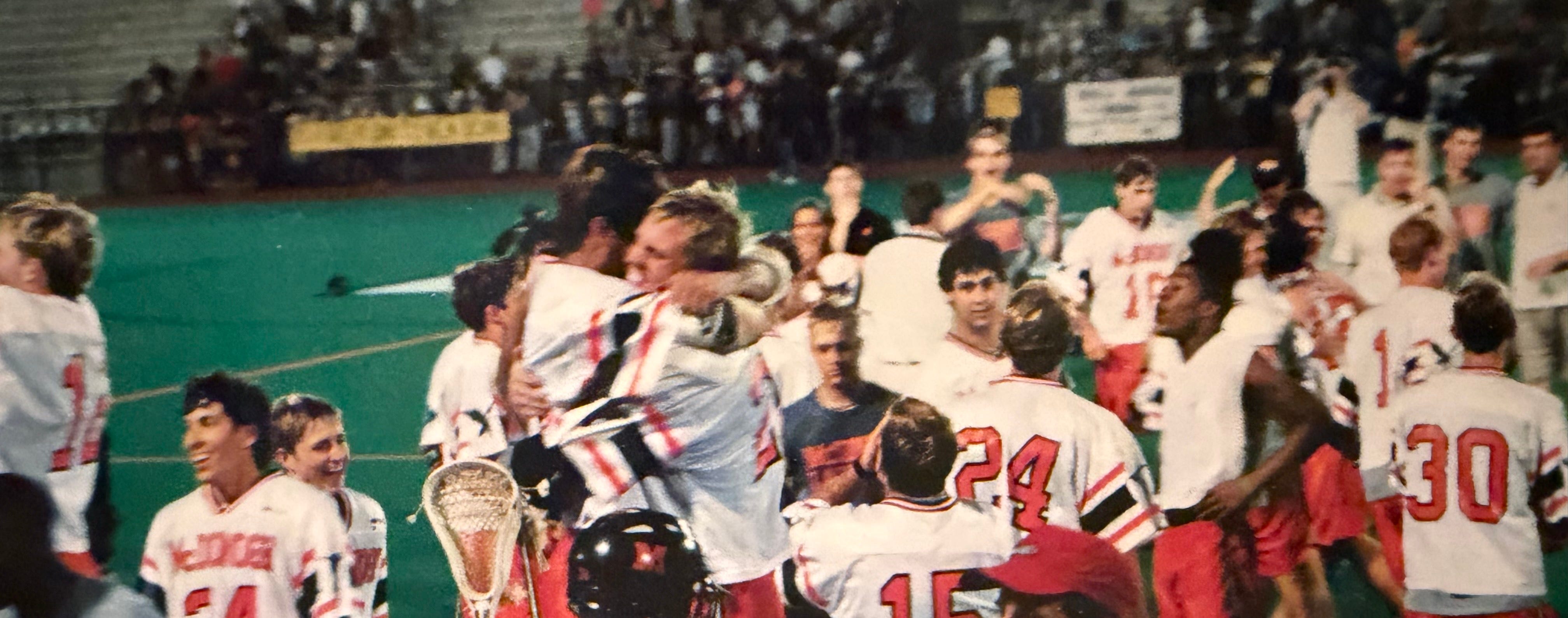
The game at Homewood Field against Loyola started very tight. The stands were packed. It felt to me like the entire state came out to see us play. Everyone played well. Loyola was pressing out aggressively on the midfield which left a lot open in the middle of the offense for other players like Brennan. We played our standard unselfish game. We all have one particular example of this below from an unscripted 3:3 man up set from the finals with each player looking for one more pass. Pardon the grainy VHS quality.
In my mind, the game hinged on a key play. But first, I am going to digress for a minute. I frequently speak with dads whose sons are good at soccer or basketball. I often tell them the story of one of our friends named Jon who started playing with us his junior year of high school. He was an excellent soccer player and very athletic. He went incredibly hard and was able to guard the other team’s best players. He was competitive and strong. I often use him as an example that any good athlete can pick up the game and have a great experience. Teams depend on guys like this. It is hard to win with only two or three superstars. A lacrosse team needs many different guys to be successful.
Back to the finals. It was tight. Around the middle of the game, Jon won a key, scrapping ground ball. He brought the ball down on a fast break and passed to me at point. The defense did not rotate and just guarded Matt, Bobby, and me. Jon was open across from me on the other side, just inside of the restraining line. I passed to him.
If this were a movie, the ball would move to him in slow motion with half-second clips one by one. The camera would show us being three years old on the swing set with Evan and Rob. It would show playing two-hand touch with friends in elementary school. It would show encouraging new guys to play lacrosse in middle and then in high school and Jon picking up a stick for the first time his junior year. At that moment, the camera shows all of the different players who practiced so hard in their different roles to bring us to this point together. Then, in this movie, the ball finally hits his pocket.
When he caught the ball on the fast break, he rifled a shot into the corner that seemed to shake the heavy metal goal backwards. I can remember the stadium almost feeling like it would explode. He put us up a few goals, but it felt like we were sixty goals ahead. From there, we just loaded one goal after another. We were winning by so many goals that Coach Reed subbed out the entire attack and defense by the fourth quarter. Our backup attackmen scored at least two goals. Our role players got on the field one by one. We completely crushed Loyola 18-8 in one of the biggest finals wins in the recent history of the league. We had broken the overtime curse and won the title for the first time since 1939. Each guy could honestly feel like he had played one of the best games of his life, and we feel this way to this day
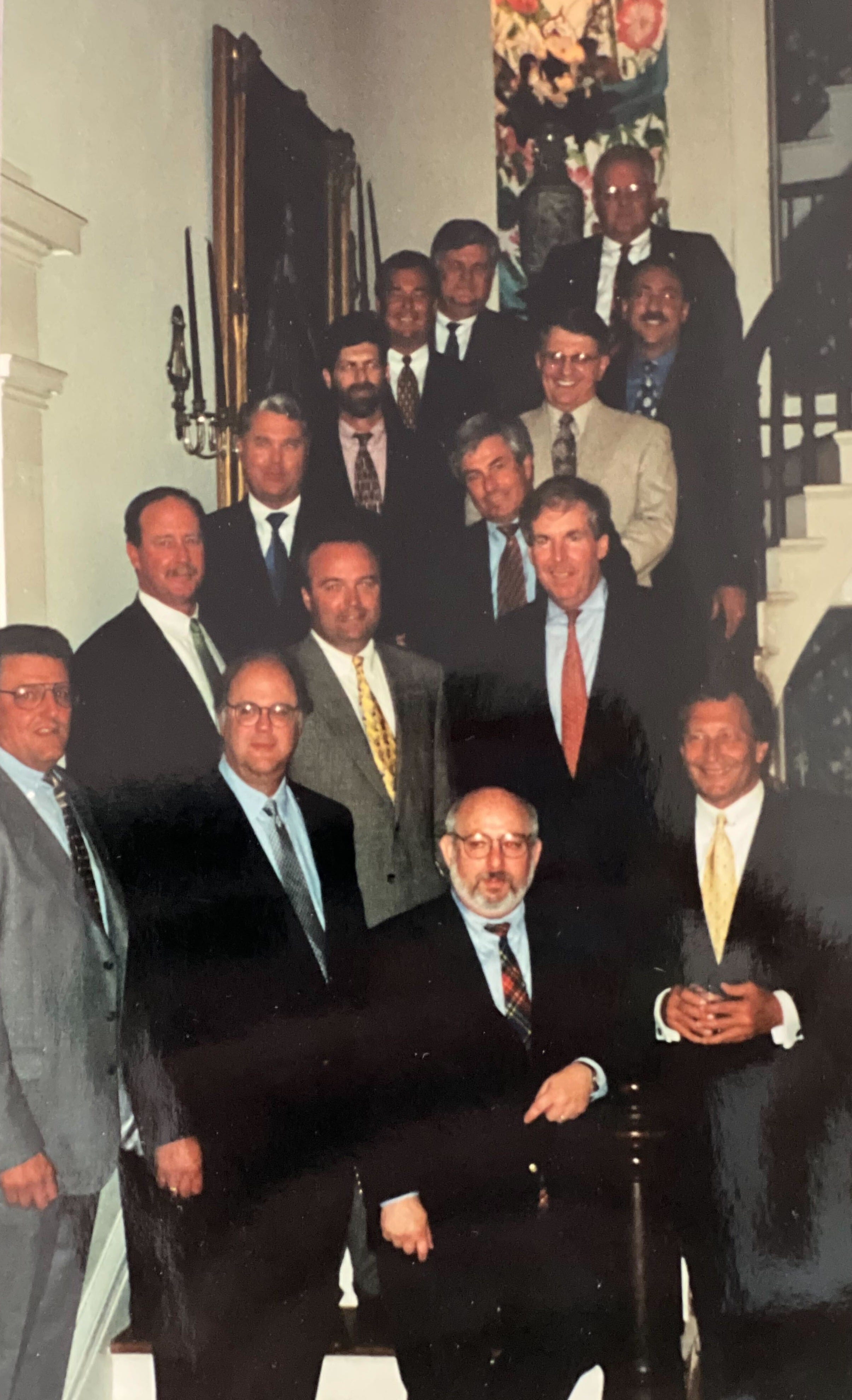
A few weeks later, we had a dinner with our parents at a fancy restaurant. They all knew each other well. We were friends, excited for what would happen in college. Some of those men have passed away, but in our minds, looking at them, it’s as if they were men built out of granite, each like great uncles to us.
Some of us played in the Lake Placid tournament together and for the same summer league team after school ended. Joe and I took jobs in downtown Baltimore and had power lunches over Blimpie subs every day. We did not know what to expect in college. We were excited about our roommates and how college lacrosse would play out.
Coda
I played lacrosse in college often against players from McDonogh. Evan and Joe even guarded me at different moments which was great fun. I had to tell my coaches to watch out for my old McDonogh teammates when we went up against them. I think we may have had to quadruple team Matt when we played against him. After college, I lived in India and then moved to New York City and did not touch a lacrosse stick for a long time. Maybe it felt a bit like a priest never seeing a rosary bead for a while.
I was excited to attend my ten year high school reunion, but I had a lot of mixed emotions about lacrosse. I had not won any championships in college whereas some of my friends had. I was not an All American, although I had a lot of fun playing in college and made a lot of great friends. I felt a little jealous and somewhat apprehensive heading into that evening with old McDonogh friends. I did not really know what to expect.
That set of drinks with those old pals was one of the best nights. I remember seeing Matt and Bobby, my two blood brothers on left and right attack, for the first time in the same place in a decade. It was like having two extra parts of myself reunited. They were so important in my life for so long. In my normal life, I was just making spreadsheets and having meetings about balance sheets. Seeing them resurrected that old special self that still existed. I saw those other friends who were each so warm and happy to see me too. I saw Evan and Rob, my two buddies who went to preschool with me and were on that same 1999 team. No one had an experience in college or beyond that was quite the same, even the very best players on the very best teams. Each had some sense that playing with old friends was hard to top!
Seeing these old pals led to new beginnings. Joe and I ended up coaching together in San Francisco. And about five years ago, with the new Sixes format upon us, we made a big push to get the group back together. In what I think was the first over forty Sixes tournament in the whole country, this same McDonogh crew from 1999 won the PLL’s first Sixes championship. I will admit that we had not lost any of the chemistry. It was the same unselfish, delightful way of playing the game.
I recently returned to campus at McDonogh. I asked the team if they see guys throwing against the wall when they walk around campus or the gym in the winter. They all nodded yes. That is the legacy and that cultural change for which we can all be grateful and proud.
This document is for informational purposes only and does not constitute an offer to sell or the solicitation of an offer to purchase any securities or investment advisory services. I am the Portfolio Manager of Barca Capital, LLC, but the views I express are my own and not necessarily those of my firm, obviously. I have to write this.